

What Torque Does an Implant Motor Really Need?
For dental device OEMs and engineers designing dental implant systems, one question consistently arises: What torque does an implant motor really need? Many manufacturers mistakenly prioritize speed over torque stability, overlooking the critical role torque plays in surgical safety, implant success, and device reliability. This guide breaks down the key factors that determine the right torque for dental implant motors, helping you avoid common pitfalls and select a motor that aligns with clinical requirements. With deep expertise in supporting dental OEMs, FingerAct understands how torque impacts every stage of the implant procedure—and how to match motor torque to your specific device needs.
Why Torque Matters More Than Speed in Dental Implant Motors
Why Torque Matters More Than Speed in Dental Implant Motors
In dental implant procedures, torque control is the cornerstone of safe and effective treatment—far more critical than maximum speed. Unlike general industrial motors, implant motors operate in a dynamic environment where bone resistance changes continuously during drilling and placement. A motor with unstable torque can lead to costly errors: uneven drilling, implant instability, or even damage to surrounding bone and soft tissue.
Speed is important for efficiency, but torque directly dictates the motor’s ability to handle variable loads. For example, when drilling into dense bone, the motor must deliver consistent torque to maintain progress without stalling or applying excessive force. When seating the implant, precise torque control ensures the implant is secured without over-tightening, which can crack the bone or compromise the implant’s long-term stability. Simply put, torque stability determines the clinical safety and performance of your dental implant device.
Key Factors That Determine Implant Motor Torque Requirements
1. Implant Size and Design
2. Bone Density
-
High-density bone (e.g., posterior mandible): Requires higher torque (40–60 N·cm) to drill through and seat the implant securely.
-
Medium-density bone (e.g., anterior mandible, posterior maxilla): Needs moderate torque (30–45 N·cm) to balance stability and bone protection.
-
Low-density bone (e.g., anterior maxilla): Requires lower torque (20–35 N·cm) to prevent bone fracture or implant loosening.
3. Clinical Procedure Type
-
Drilling: Lower torque (10–25 N·cm) is used for initial pilot drilling to create a guide hole, reducing the risk of bone damage.
-
Countersinking: Moderate torque (25–35 N·cm) is needed to prepare the bone for the implant’s platform, ensuring a proper fit.
-
Implant Seating: Higher torque (20–60 N·cm, depending on size and bone density) is required to secure the implant in place, with real-time torque feedback to prevent over-tightening.
Got questions about implant motor torque?
Email your requirements to info@fingeractuation.com
Get a personalized torque recommendation quickly.
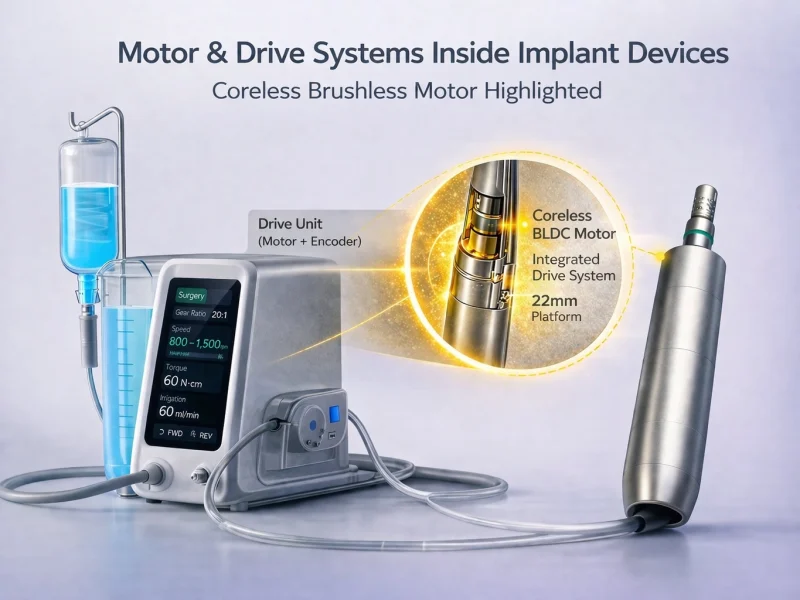
Coreless motor integration inside implant handpiece, highlighting compact drive system for dental OEM applications.
Typical Torque Ranges for Dental Implant Motors
Based on industry standards and clinical best practices, the following torque ranges are recommended for most dental implant systems. These ranges balance safety, performance, and compatibility with common implant designs and bone densities:
• Minimum torque: 20 N·cm (suitable for small implants in low-density bone)
• Average torque: 30–45 N·cm (ideal for medium-sized implants in medium-density bone, the most common clinical scenario)
• Maximum torque: 60 N·cm (for large implants in high-density bone)
It’s important to note that these are general guidelines—your specific torque requirements may vary based on your device’s unique design and target market. FingerAct’s engineering team can help you test and validate the optimal torque range for your implant system.
Common Mistakes in Torque Selection for Implant Motors
Even experienced OEMs can make mistakes when selecting torque for dental implant motors. Avoiding these pitfalls will save time, reduce development costs, and ensure your device meets clinical standards.
Mistake 1: Prioritizing Maximum Torque Over Torque Stability
Mistake 2: Using a One-Size-Fits-All Torque Setting
Mistake 3: Overlooking Torque Feedback Integration
How FingerAct Helps You Select the Right Torque for Your Implant Motor
Selecting the right torque for your dental implant motor requires a deep understanding of clinical requirements, device design, and motor performance. FingerAct supports dental OEMs throughout this process, from torque requirement analysis to motor customization and integration.
Our services include:
• Torque requirement assessment: Working with your team to determine the optimal torque range based on your implant size, design, and target clinical scenarios.
• Motor customization: Adjusting motor torque settings, feedback systems, and size to fit your device’s unique constraints.
• Integration support: Ensuring the motor’s torque performance aligns with your gearbox, driver, and control system for seamless operation.
Quick Torque Selection Checklist
• ☑️ Define your implant size range (small, medium, large) to narrow down torque requirements.
• ☑️ Consider the target bone densities your device will be used in (low, medium, high).
• ☑️ Ensure the motor has adjustable torque settings to accommodate different clinical stages.
• ☑️ Prioritize torque stability over maximum torque rating.
• ☑️ Verify integration with torque feedback systems (encoders, sensors) for clinical safety.
Need custom torque solutions for your dental implant motor?
We support OEMs from torque assessment to full integration.
Contact us to discuss your project today. 🛠️


