
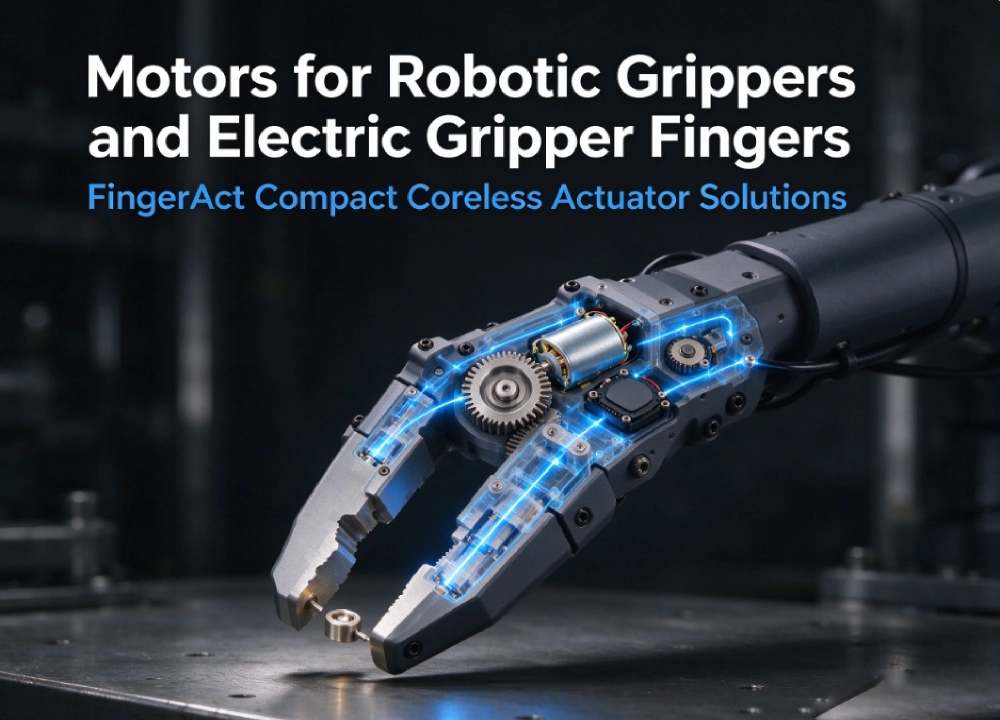
Motors for Robotic Grippers and Electric Gripper Fingers: FingerAct Compact Coreless Actuator Solutions
A robotic gripper motor is the component that determines whether an electric gripper can grip firmly, release quickly, and hold reliably without overheating. As factories and collaborative robot cells move away from pneumatic grippers toward electric actuation, the robotic gripper motor becomes a critical selection decision. Electric grippers offer programmable force, position feedback, and no compressed air supply, but they demand an actuator that is compact, controllable, and efficient. This article explains what a robotic gripper motor must deliver in a robotic gripper and electric gripper finger application, and how FingerAct’s coreless actuator solutions address these requirements.
What an Electric Gripper Needs from Its Motor
An electric gripper replaces compressed air with an electric actuator driving the gripper fingers through a gearbox and mechanism. A robotic gripper motor must therefore provide:
- Gripping torque: enough to hold the workpiece without slipping
- Closing speed: fast enough to meet cycle time targets
- Holding torque: continuous output while the object is grasped
- Low stall current: protection when the gripper closes on nothing or reaches end of travel
- Position feedback: for closed-loop control and force regulation
- Compact size: the actuator must fit inside the gripper body or robot wrist
Unlike a prosthetic hand, an industrial gripper is a production tool. It runs thousands of cycles per shift, so durability and repeatability matter as much as peak performance.
Typical Gripper Architectures and Actuator Count
| Gripper Type | Actuator Arrangement | Typical Motor Requirement |
|---|---|---|
| Two-finger parallel gripper | One motor driving both fingers via rack-and-pinion or linkage | 12–22 mm diameter, 0.1–0.5 N·m |
| Three-finger centric gripper | One motor driving all fingers through a scroll or linkage | 16–22 mm diameter, 0.2–0.8 N·m |
| Adaptive / self-centering gripper | One motor per finger or one motor with compliant mechanism | 12–16 mm diameter, 0.1–0.3 N·m |
| Electric gripper finger module | One independent actuator per finger | 12–16 mm diameter, 0.05–0.2 N·m |
For a two-finger gripper motor, a single actuator with a reversing mechanism is common. For an adaptive gripper motor, independent finger actuation provides better shape conforming. The electric gripper finger motor in modular designs must be small enough to fit inside each finger body.
Need motor selection?
Email to info@fingeractuation.com
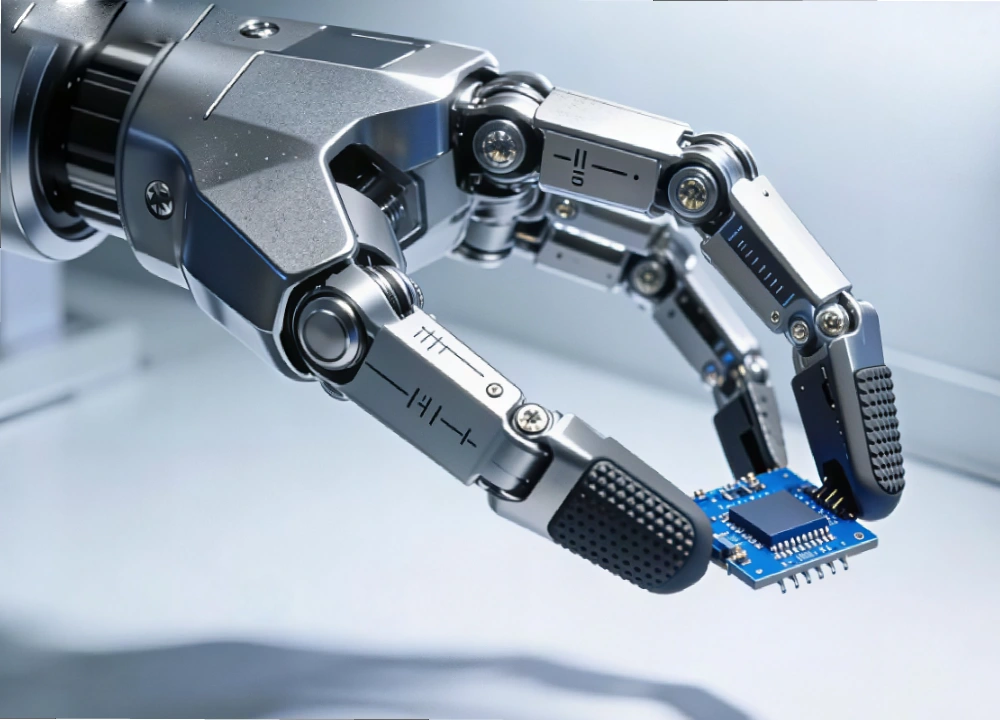
Metal dexterous robotic hand gently gripping a circuit board, showcasing compact tendon-driven robot finger technology powered by miniature coreless actuators.
Motor Selection Parameters
Sizing a robotic gripper motor starts from the required grip force and finger geometry:
Grip force → required tendon or linkage force → gearbox output torque
Finger travel → gearbox output rotation → required output speed
Cycle time → closing and opening speed
Holding duration → continuous torque and thermal capacity
Control method → encoder resolution and current-loop capability
A compact planetary gearbox for gripper is the standard speed reducer in this application. Reduction ratios typically range from 20:1 to 200:1, depending on whether the gripper uses a leadscrew, rack-and-pinion, or linkage mechanism. Backlash must be low because it directly affects gripping repeatability.
An integrated encoder for gripper motor enables position control and stall detection. A two-channel incremental quadrature encoder with 3.3 V or 5 V logic is sufficient for most gripper controllers.
Why Coreless Motors Suit Electric Grippers
A coreless motor for robotic gripper offers several advantages in this application:
- No cogging: smooth motion at low speed, important for gentle gripping and fine position control
- Low rotor inertia: fast opening and closing response
- High power density: a miniature actuator for electric gripper can deliver useful torque in a small package
- Linear torque-current relationship: simplifies force control and current limiting
- Low noise: important in collaborative robot cells where humans work alongside robots
Brushed coreless motors are common in cost-sensitive gripper designs because they can be driven by a simple H-bridge. Brushless coreless motors are preferred where duty cycle is high and efficiency matters.
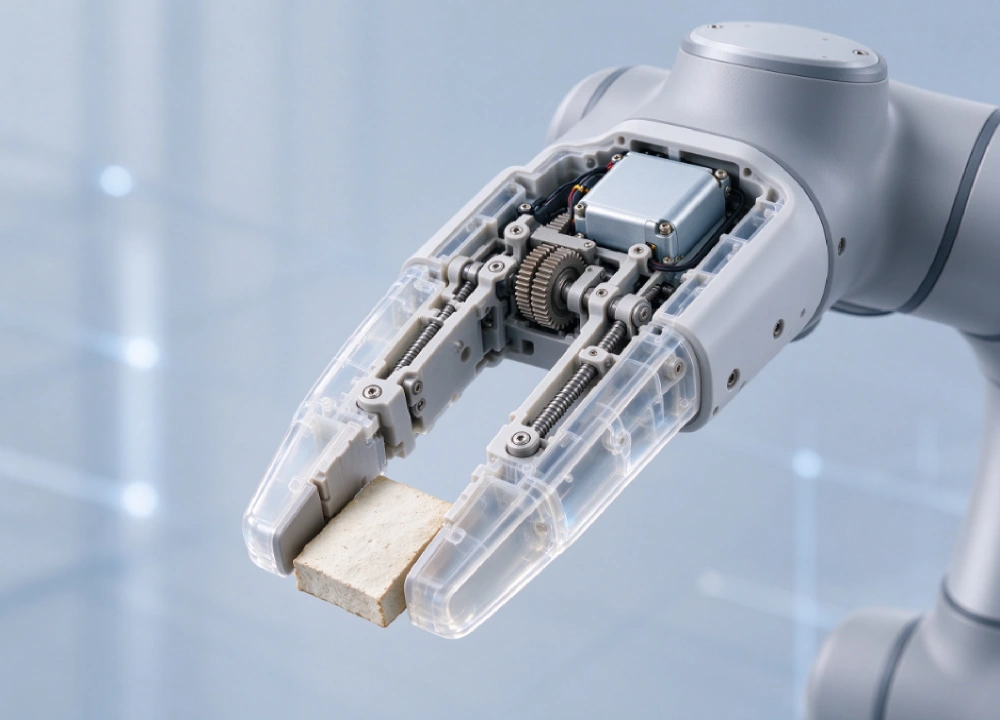
FingerAct Actuator Solutions for Robotic Grippers
FingerAct provides integrated actuator units combining a robotic gripper motor, planetary gearbox, and optional encoder. The typical configurations for gripper applications are:
12–13 mm brushed coreless motor + 2–3 stage planetary gearbox + incremental encoder: suited to compact electric gripper fingers and adaptive gripper modules
16 mm coreless motor + planetary gearbox: suited to two-finger and three-finger grippers requiring higher grip force
22 mm coreless motor + planetary gearbox: suited to larger industrial grippers and heavy payload applications
For robotic gripper actuator selection, the process is straightforward: define grip force and cycle time, calculate gearbox output torque and speed, select the motor diameter that fits the available space, and confirm thermal capacity for the duty cycle. FingerAct engineering support can help match the gearbox ratio and encoder configuration to your controller.
More details on our coreless motor and gearmotor platforms are available on our product pages. If you are comparing actuator options for a new gripper design, the FingerAct team can review your requirements and recommend a configuration. You can also find related application notes on robotic and prosthetic actuators within our technical resource library.
If you are working on dexterous robotic hands with cable-driven structures, read our guide on Motors for Tendon-Driven Robotic Fingers.
Summary
A robotic gripper motor must balance grip force, closing speed, holding capability, stall protection, and packaging size. Coreless DC motors with compact planetary gearboxes and integrated encoders provide a practical actuator solution for electric grippers and electric gripper fingers. FingerAct supplies these integrated actuator units in 12–22 mm diameter ranges and supports robotic gripper actuator selection with engineering guidance. For gripper designs where space is tight and control performance matters, a coreless-based robotic gripper motor is a strong starting point.
Need a small actuator sample for your gripper prototype testing?
Our 12–22 mm integrated coreless gear motors are ready for evaluation on collaborative robot gripper fingers.
👉 Request sample details.


