
Motors for Tendon-Driven Robotic Fingers: FingerAct Compact Coreless Actuator Solutions
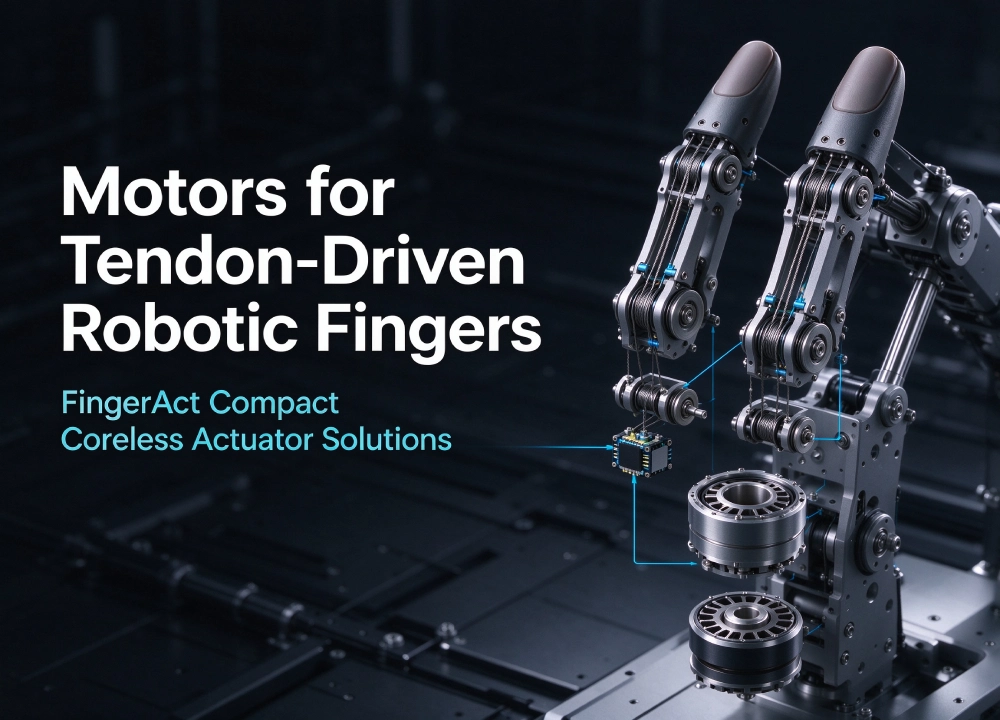
A tendon driven robotic finger is one of the most elegant solutions to a persistent engineering problem: how do you pack enough actuation power into a finger that must remain thin, light, and human-like in appearance? The answer, borrowed directly from human anatomy, is to move the motors out of the fingers themselves and into the palm or forearm, then transmit force through cables or tendons. This architecture, known as a tendon driven robotic finger, allows the finger structure to stay simple and lightweight while the actuators sit in a space where they can be larger, better cooled, and more easily serviced.
FingerAct specializes in the compact actuator technology that makes this architecture practical. For developers building tendon-driven hands, the critical decision is actuator selection: motor type, gearbox ratio, encoder integration, and mechanical interface. This article explains the engineering requirements for a tendon driven robotic finger and presents FingerAct’s coreless motor solutions for these demanding applications.
Why Tendon-Driven Architecture
The Anatomy-Inspired Approach
The human hand contains no muscles inside the fingers. Instead, muscles in the forearm connect to finger bones through tendons that route over pulleys at each joint. This design keeps the fingers remarkably light while allowing powerful grip forces. A tendon driven robotic finger copies this principle: actuators are placed in the palm, forearm, or an external housing, and cables transmit force to the finger joints.
This architecture has become a mainstream approach for high-degree-of-freedom robotic hands. Industry analysis identifies “coreless motor + micro reducer + tendon-driven structure” as the primary technical route for anthropomorphic dexterous hands, delivering human-like finger appearance and fine manipulation performance.
Key Advantages for Robotic Fingers
- Reduced finger mass and inertia: With no motor inside the finger, the moving mass is only the finger structure and tendon. This enables faster dynamic response and safer interaction with humans and objects.
- Simplified finger structure: A tendon driven finger actuator located remotely means the finger itself contains only joints, pulleys, and cable routing. This reduces complexity and allows smaller finger dimensions.
- Flexible actuator placement: Motors can be positioned wherever space and thermal management allow—palm, forearm, or an external pack. For a miniature actuator for tendon driven finger, this frees the designer from the extreme size constraints of finger-embedded solutions.
- Underactuation capability: A single tendon driven robotic finger actuator can drive multiple joints through a coupled tendon path, reducing the total actuator count while preserving natural-looking motion.
Need motor selection? Email to info@fingeractuation.com

FingerAct worker is doing Dental motor testing and quality inspection in our in-house production line for OEM applications
Actuator Requirements for Tendon-Driven Fingers
The Core Challenge: Compact Power
A tendon driven finger actuator must deliver sufficient torque and speed within a package small enough to fit in the available palm or forearm volume. This is fundamentally a power density problem. The actuator must overcome finger joint friction, tendon routing losses, return spring forces, grasp loads, and finger inertia during rapid movements.
Industry practice for robotic hand actuation favors miniature coreless motors in the 6–10 mm diameter range for finger-scale actuators, with larger 10–16 mm motors used when higher grip forces are required.
Torque and Speed Targets
For a typical finger-scale tendon-driven system, the actuator output requirements depend on spool radius and required tendon tension:
| Parameter | Typical Range | Notes |
|---|---|---|
| Motor diameter | 6–16 mm | 8–10 mm balances size and power |
| Rated voltage | 6–24 V | 12 V common for battery-powered systems |
| Gearbox output torque | 0.05–0.30 N·m | Depends on grip force target and spool radius |
| Gearbox output speed | 30–150 RPM | Faster for closing speed, slower for grip force |
| Reduction ratio | 50:1–500:1 | Multi-stage planetary typical |
A finger closing time of 0.5–1.3 seconds is achievable with well-matched actuators. Higher output speeds enable faster closing but may reduce available grip force for a given motor power.
Special Requirements for Tendon-Driven Systems
A coreless DC motor tendon driven system has unique demands beyond basic torque and speed. The actuator needs bidirectional operation for flexion and extension, stable intermittent holding torque, low stall current, and controllable backdrivability. A planetary gearbox for robotic finger with low backlash supports precise position control for this tendon layout.
Motor Technology Selection
A tendon driven robotic finger requires an actuator that balances low inertia, high power density and compact dimensions. For tendon driven robotic finger projects, brushed coreless DC motors are the most widely adopted option, outperforming conventional iron-core motors in lightweight robotic hand designs.
Coreless motors eliminate iron losses and rotor inertia, delivering fast response critical for tendon transmission systems. Paired with a miniature planetary gearbox, they generate sufficient torque for grasping while keeping the actuator small enough to fit inside the palm or forearm. An integrated encoder is also essential for closed-loop position control of each tendon driven robotic finger.
| Motor Type | Pros for tendon driven robotic finger | Limitations |
|---|---|---|
| Brushed Coreless DC Motor | Low rotor inertia, fast response, high power density, compact size | Limited service life under continuous heavy duty |
| Iron-core DC Motor | Lower cost, high torque | Heavy rotor, slow response, too bulky for palm mounting |
| Micro Stepper Motor | Simple position control | Poor dynamic response, low efficiency, heavier package |
When sizing an actuator for tendon driven robotic finger, engineers should prioritize continuous torque, output speed and overall assembly diameter. Typical requirements for a single tendon driven robotic finger actuator are 0.2–0.3 N·m continuous torque, 40–100 RPM output speed, and 12–16 mm outer diameter.
FingerAct Compact Coreless Actuator Solutions
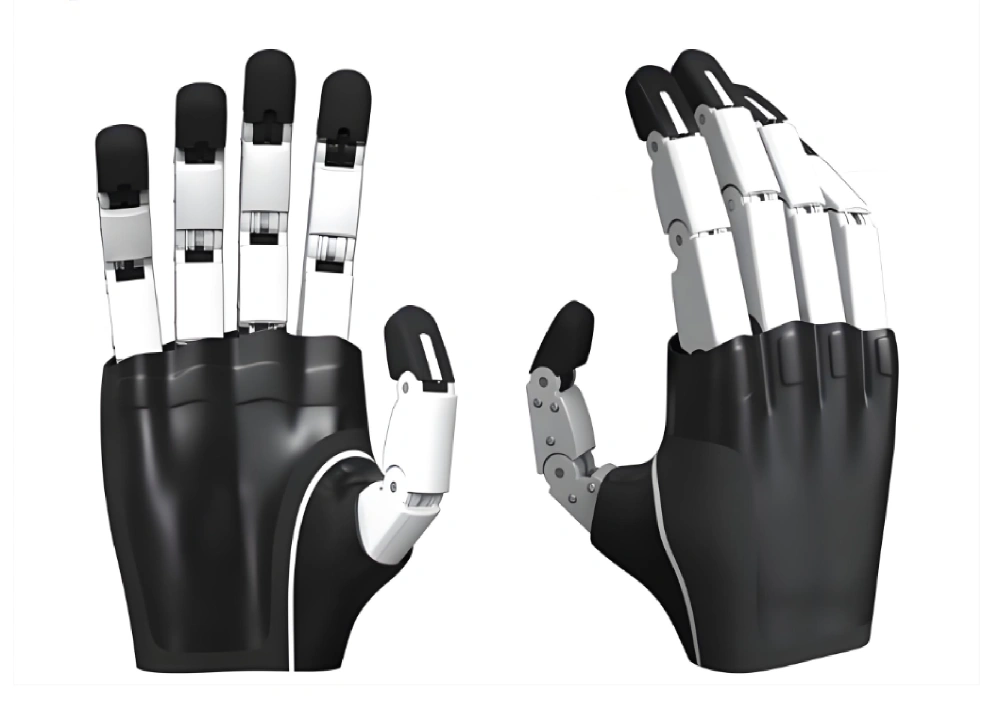
FingerAct supplies integrated coreless actuator assemblies tailored for tendon driven robotic finger systems. Our combined brushed coreless motor, planetary gearbox and encoder modules are designed for palm or forearm installation, ideal for multi-finger tendon driven robotic hand prototypes.
FingerAct’s pre-integrated modules remove the complexity of separate component sourcing and mechanical matching. Engineers developing tendon driven robotic finger can directly evaluate our off-the-shelf assemblies, or request custom shaft, reduction ratio and mechanical interface modifications.
FingerAct’s coreless actuator lineup supports the tight dimensional constraints common in tendon-driven robotic hand, prosthetic and rehabilitation robot projects. You can view our full coreless motor and gearmotor portfolio on our product page.
For more details about actuator requirements for bionic dexterous hands used in amputation prosthetics, read our guide: Motors for Myoelectric Prosthetic Hands.

Application Use Cases
These compact coreless actuators built for tendon driven robotic finger serve multiple advanced robotics projects:
- Humanoid robot dexterous hands
- Myoelectric prosthetic hands for amputees
- Rehabilitation exoskeleton hand devices
- Lightweight research robotic grippers
A tendon driven robotic finger architecture demands actuators that are compact, powerful, efficient, and precisely controllable. The tendon driven robotic finger motor must deliver torque and speed through a gearbox while fitting within severe packaging constraints. FingerAct’s coreless motor for tendon driven hand solutions—combining compact coreless motors, custom planetary gearboxes, and integrated encoders—address these requirements directly.
The tendon-driven robotic finger motor selection process should prioritize sufficient torque, proper closing speed, low cogging, encoder feedback, and thermal capacity. For developers undertaking robotic finger actuator selection, our integrated actuator units and engineering support help translate these requirements into a working design.
Working on dexterous hand or bionic prosthetic development?
Talk to our actuator engineers to select matched planetary gearbox + coreless motor assembly for your tendon drive system.


