
Why Sterilizable Motors Matter in Dental Applications
For dental device OEMs and design engineers, motor sterilization compatibility is not an optional upgrade—it is a mandatory engineering baseline. Unlike industrial motors that work in clean and stable environments, dental motors are installed inside handpieces that undergo repeated autoclave sterilization, high temperature, high pressure, and humid steam penetration in daily clinical use. Using non-sterilizable or poorly sealed motors will lead to rapid component failure, safety risks, and shortened device lifespan. This article explains why sterilizable motors are irreplaceable in dental applications, core technical requirements, common failure causes, and key integration advice for OEM product development.
Core Reason: Dental Devices Face Harsh Repeated Sterilization Cycles
Core Reason: Dental Devices Face Harsh Repeated Sterilization Cycles
Key Technical Requirements for Qualified Sterilizable Dental Motors
Key Technical Requirements for Qualified Sterilizable Dental Motors
1. Hermetic Sealing Structure
2. High-Temperature Resistant Materials
3. Anti-Corrosion and Moisture-Proof Design
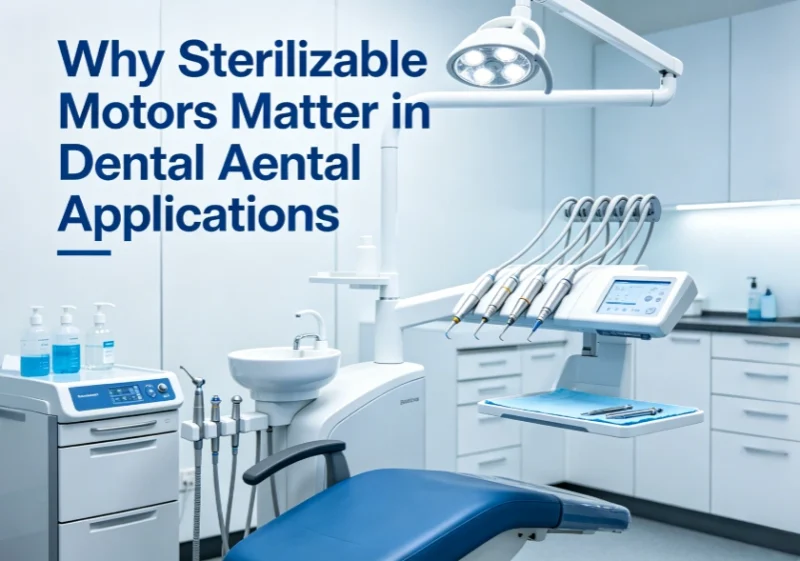
This cover shows a clean, modern dental clinic, highlighting the importance of sterilizable motors for safety and hygiene in dental care.
Risks of Using Non-Sterilizable Motors in Dental Devices
Risks of Using Non-Sterilizable Motors in Dental Devices
-
Performance Attenuation: After repeated sterilization, the magnetic performance decays and the winding resistance changes, causing unstable speed and insufficient torque, which affects surgical precision.
-
Frequent Failure and High After-Sales Cost: Non-sterilizable motors are prone to short circuits and dead stops, requiring frequent replacement and increasing after-sales pressure for manufacturers.
-
Clinical Safety Risks: Unsealed structures may breed bacteria, failing hospital infection control standards and causing clinical safety hazards.
-
Product Certification Obstacles: Non-standard motor solutions cannot pass medical device related certification, restricting product market promotion.
-
Brushed Motors: The internal brush and commutator friction structure has gaps. Steam easily enters and causes carbon deposition and corrosion. The service life drops sharply after repeated sterilization, so it is only suitable for low-end disposable or low-frequency use equipment.
-
Brushless Motors: No mechanical friction structure, easy to achieve full sealing. With high-temperature resistant materials and integrated design, they can stably adapt to long-term cyclic autoclaving, becoming the mainstream solution for mid-to-high-end dental clinical equipment.
Common OEM Design Mistakes to Avoid
-
Confusing industrial motors with medical motors: Industrial motors focus on continuous work stability at room temperature, without considering high-temperature sterilization impact, and cannot be used in dental clinical scenarios.
-
Only checking static temperature resistance parameters: Short-term high-temperature resistance does not represent cyclic sterilization resistance. Long-term aging and attenuation performance must be verified.
-
Ignoring sealing matching with handpieces: Even if the motor itself is well sealed, unreasonable handpiece structural gaps will lead to steam backflow and affect overall durability.
Quick Selection Checklist for Sterilizable Dental Motors
Quick Selection Checklist for Sterilizable Dental Motors
-
☑️ Support repeated 134°C autoclave sterilization cycles
-
☑️ Adopt hermetic sealing & medical-grade anti-corrosion housing
-
☑️ Equipped with high-temperature resistant winding and internal components
-
☑️ Choose brushless structure for long-term sterilization stability
-
☑️ Verify no performance attenuation after cyclic aging tests


