
Motors for a Myoelectric Prosthetic Hand: FingerAct Actuator Solutions for a Dexterous Hand
A dexterous hand is one of the most demanding engineering challenges in bionic prosthetics. For teams developing a myoelectric prosthetic hand for amputees, the core problem is always the same: how to fit enough high-performance actuators into the limited space of a palm and forearm so that five fingers can move independently, precisely, and reliably. The actuator choice for a dexterous hand directly determines grip force, response speed, battery life, and wearing comfort. This article walks through the motor selection logic for a dexterous hand based on a real myoelectric prosthetic hand prototype requirement, and presents FingerAct’s integrated actuator solution.
At FingerAct, we work with exactly this kind of compact motion problem. You can explore our coreless motor series, and this article explains how we would approach a five-finger prosthetic hand architecture.

Actuator Requirements for a Myoelectric Prosthetic Hand
Typical Application Scenario
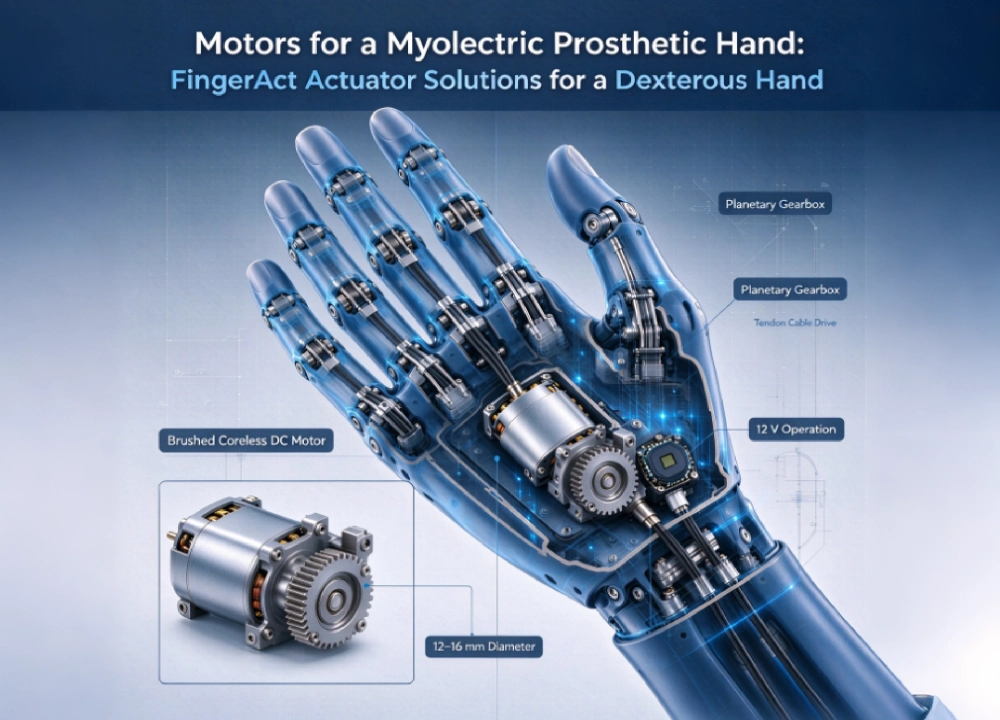
A myoelectric prosthetic hand prototype currently under development uses five independently actuated fingers. Each finger is driven by a separate actuator through a tendon/cable mechanism, and all drive units must fit inside the prosthetic forearm or palm. This means each actuator must deliver sufficient torque and speed within an extremely compact envelope while keeping power consumption low, because five motors operate from a shared battery-powered system.
The current technical target can be summarized as: 12–16 mm motor diameter, 12 V operation, 0.20–0.30 N·m continuous output torque, 40–100 RPM gearbox output speed, and gearbox reductions in the approximately 140:1–200:1 range. Control is provided by an ESP32 microcontroller through an external bidirectional H-bridge motor driver, with an integrated two-channel incremental quadrature encoder compatible with 3.3 V logic for closed-loop position control of each finger.
The customer’s own description is precise: “We are developing a myoelectric prosthetic hand prototype using five independently actuated fingers. We are looking for a compact brushed coreless DC motor, planetary gearbox, and encoder assembly suitable for installation in the palm or forearm, with one actuator controlling each finger through a tendon/cable mechanism.” This is a classic prosthetic hand actuator requirement.
Why a Brushed Coreless DC Motor
In dexterous hand drive architectures, the brushed coreless DC motor is the preferred starting point for myoelectric prosthetic finger actuation. Unlike conventional iron-core DC motors, a coreless motor uses a self-supporting rotor coil with no iron teeth, which eliminates cogging torque and eddy current losses.
These structural advantages map directly onto prosthetic hand needs:
- Smooth low-speed operation: No cogging means finger motion has no jerkiness, producing a more natural grasp.
- High power density: Within a 12–16 mm diameter constraint, a coreless motor delivers higher output per unit volume than a conventional brushed motor.
- Low rotor inertia: Faster start-stop response, suitable for prosthetic hands that open and close frequently.
- Low noise and vibration: Prosthetic users are sensitive to noise; coreless motors run noticeably quieter than iron-core motors.
Brushed vs brushless: A brushed coreless motor has a simpler structure and lower drive electronics cost, and can be driven directly by an external H-bridge. A 12 V brushed version in the 12–16 mm diameter range has mature, proven production solutions. A brushless coreless motor offers higher efficiency and longer life, but requires additional commutation control electronics, which increases the electronic system complexity inside the forearm. For a prototype-stage myoelectric prosthetic hand project, a brushed coreless DC motor is the more pragmatic starting point.

The Role of the Gearbox: Why a Compact Planetary Gearbox
A coreless motor’s raw output is high speed and low torque. A 12 mm brushed coreless motor typically has a no-load speed in the 10,000–20,000 RPM range, while rated torque may be only a few mNm. To drive a finger to grasp a 1 kg object, the speed must be reduced to 40–100 RPM while torque is amplified to 0.20–0.30 N·m.
A compact planetary gearbox is the best choice for this conversion. Compared with harmonic or RV reducers, planetary gearboxes have clear advantages in miniaturization: small size, low weight, high single-stage efficiency (88%–98%), and multi-stage stacking that easily achieves 140:1 to 200:1 reduction. For a five-finger independently actuated architecture, a compact planetary gearbox means five actuator units can be arranged side by side inside the forearm.
Reduction ratio recommendation: The customer’s current consideration of 140:1–200:1 is reasonable. A ratio closer to 140:1 favors finger closing speed (corresponding to roughly 70–100 RPM output), while a ratio closer to 200:1 favors grip force. Because tendon/cable transmission introduces additional friction losses and elastic deformation, we recommend starting the prototype at a mid-range ratio of 160:1–180:1 to balance speed and torque.
Need actuator selection support for your dexterous hand prototype?
Share your space & torque requirements.
Email us: support@fingeract.com
Get custom actuator proposal → Contact Us

Servo motor application in dexterous robotic hand for precise grasping and force control.
FingerAct’s Myoelectric Prosthetic Hand Actuator Solution
Integrated Actuator Architecture
FingerAct does not sell a motor alone. We provide an integrated actuator unit combining motor + planetary gearbox + encoder + drive adaptation. For a five-finger independently actuated myoelectric prosthetic hand, each finger’s actuator can be configured as follows:
| Parameter | Target | FingerAct Matching Direction |
|---|---|---|
| Motor type | Brushed coreless DC | 12 mm / 13 mm brushed coreless series |
| Rated voltage | 12 V | 12 V standard winding |
| Reduction ratio | 140:1–200:1 | Custom multi-stage planetary gearbox |
| Continuous output torque | 0.20–0.30 N·m | Adjusted with motor KV |
| Gearbox output speed | 40–100 RPM | Adjusted with motor KV |
| Encoder | Two-channel incremental quadrature, 3.3 V | Integrated magnetic encoder option |
| Mounting | Inside forearm/palm | Compact cylindrical package, axial leads |
Mechanical Adaptation for Tendon-Driven Robotic Finger
For a tendon-driven robotic finger architecture, the actuator output shaft connects to a spool that pulls a tendon to flex the finger joint. This transmission method imposes additional requirements:
- Bidirectional symmetric operation: Finger extension and flexion both require active drive (or elastic return), so the actuator must handle frequent forward-reverse operation.
- Intermittent holding capability: Holding an object requires continuous holding torque, and the current consumption directly affects battery life.
- Low stall current: When the tendon is fully tensioned or the finger reaches end of travel, current should not be excessive, avoiding battery voltage sag when five motors stall simultaneously.
FingerAct’s brushed coreless DC motor series offers low inductance and a linear torque-current relationship, making it well suited for current-loop control with an external H-bridge, thereby limiting power consumption during the holding phase. More details on our coreless motor series can be explored on our website.
Encoder and Closed-Loop Control
For precise position control of each finger, an integrated quadrature encoder is essential. The ESP32 can read quadrature encoder signals directly through its PCNT peripheral, achieving four-times frequency multiplication for sub-degree angular resolution.
FingerAct’s solution can integrate a 3.3 V compatible magnetic incremental encoder outputting A/B quadrature pulses. Within the 12 mm motor diameter constraint, the encoder is typically rear-mounted and does not significantly increase actuator length.
Power Consumption and Thermal Management for a Five-Actuator System
The power consumption of five actuators running simultaneously is a key constraint for a myoelectric prosthetic hand. Depending on the scenario, the distribution varies significantly:
- No-load finger open/close: Current mainly overcomes gearbox and tendon friction; power consumption is low.
- Grasping a light object (<200 g): Load torque is small; current is moderate.
- Grasping and holding a 1 kg object: Continuous torque output; current is highest and is the main drain on battery life.
FingerAct’s recommendation: at the prototype stage, first validate the torque-speed curve and temperature rise of a single-finger actuator. A 12 mm brushed coreless motor continuously outputting 0.25 N·m will experience winding temperature rise that must be kept within a reasonable range. If heat dissipation inside the prosthetic forearm is limited, derating may be necessary, or a slightly larger 13–16 mm diameter specification may be chosen to reduce thermal load.
Further Guidance on Reduction Ratio Selection
The customer mentioned they “would appreciate assistance selecting the optimal ratio.” This deserves expansion.
Reduction ratio selection is fundamentally a trade-off between speed and torque. For myoelectric prosthetic finger actuation, two key use scenarios define the requirement boundaries:
Fast closing: From fully open to object contact, users expect a response time typically within 200–400 ms. If the gearbox output speed is 80 RPM and the spool effective radius is 5 mm, the tendon linear speed is about 42 mm/s. If the finger travel from fully open to closed is about 40–60 mm, the closing time is roughly 1–1.4 s, which is on the slow side. To shorten this to under 500 ms, a higher output speed or a larger spool radius is needed.
Powerful grasp: When grasping a 1 kg object, the fingertip force depends on object shape and friction coefficient. Roughly estimating, with 70% tendon transmission efficiency, a gearbox output of 0.25 N·m and a spool radius of 5 mm gives a tendon tension of about 35 N, and the force distributed to the fingertip is typically in the 10–20 N range, sufficient for everyday object grasping.
Therefore, if speed is the priority, choose a lower ratio near 140:1; if grip force is the priority and slightly slower closing is acceptable, choose closer to 200:1. For prototype validation, we recommend starting at 160:1 and adjusting based on measured grasp performance and user feedback.
Summary
A dexterous hand myoelectric prosthetic hand for amputees has core drive requirements that can be summarized as: miniaturization, high torque density, low power consumption, and closed-loop controllability. A brushed coreless DC motor combined with a compact planetary gearbox and an integrated incremental encoder is the most pragmatic technical route at the prototype stage.
FingerAct’s recommended solution is: 12–13 mm brushed coreless motor + custom planetary gearbox (starting at 160:1) + 3.3 V incremental quadrature encoder, delivered as an integrated actuator unit, one unit per finger, five units sharing a 12 V battery system, with independent closed-loop control via ESP32 and external H-bridges. If higher efficiency and longer life are needed later, the system can be upgraded to a brushless coreless solution after the validation stage.
For further discussion on specific model selection, reduction ratio calculation, or integrated packaging, please share your detailed load curve and installation space constraints. The FingerAct engineering team will match a suitable actuator configuration for your dexterous hand project. We can customize the actuator dimensions and winding parameters for your prosthetic prototype. You can also explore our coreless motor series on our website.
📦 Looking for integrated motor gearbox encoder for myoelectric prosthetic hand?
We customize compact brushed coreless assemblies.
Discuss your project → Send RFQ


