
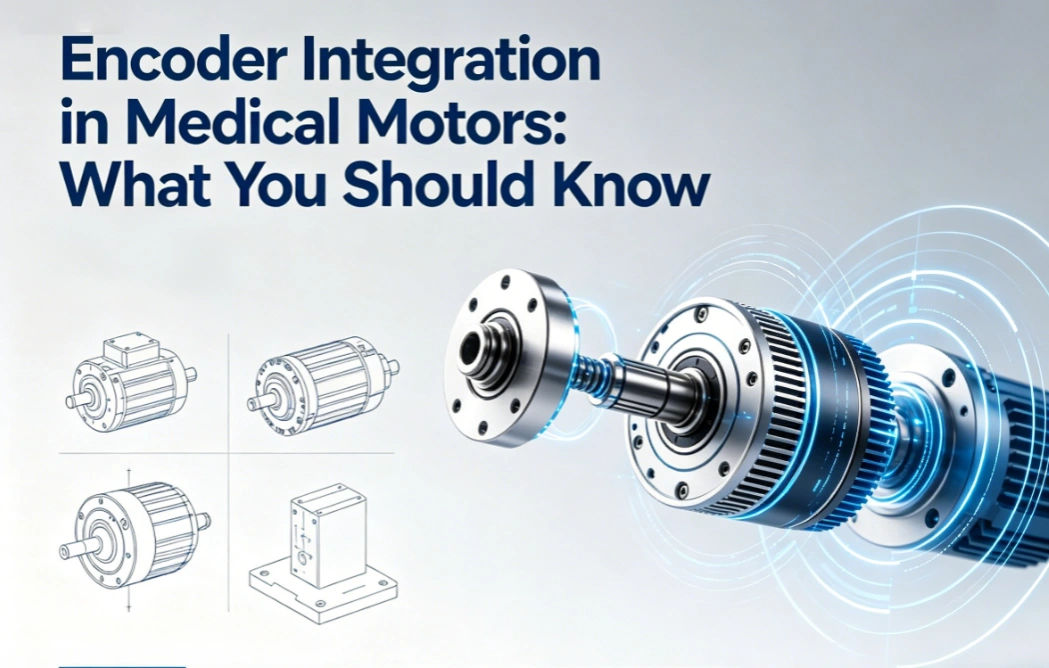
Encoder Integration in Medical Motors: What You Should Know
For medical and dental device OEMs, encoder integration is the core of precision motor control. Unlike ordinary industrial motors that tolerate minor speed deviations, medical motors used in endodontic treatment, implant drilling, and minimally invasive procedures require micro-level speed and position accuracy. A well-matched encoder system ensures stable torque output, precise motion feedback, and consistent clinical performance. Many integration failures, such as speed fluctuation, torque jitter, and instrument breakage, stem from mismatched encoder parameters or improper structural integration. This article breaks down the key principles of medical motor encoder integration, common engineering challenges, and actionable best practices to help engineers design reliable medical motion systems.
Why Encoders Are Critical for Medical & Dental Motors
Why Encoders Are Critical for Medical & Dental Motors
In medical motor systems, the motor provides power, while the encoder delivers “precision judgment”. Medical devices rely on closed-loop feedback to correct real-time operating status, which is indispensable for high-precision clinical operations.
-
Stable Speed Regulation Under Variable Loads: During bone drilling or root canal shaping, motor load changes dynamically. The encoder feeds back real-time speed data for the driver to adjust current, avoiding speed drop and ensuring consistent cutting precision.
-
Accurate Torque Limiting: Precise pulse feedback enables micro torque adjustment, preventing excessive torque that causes file breakage, bone damage, or device jitter.
-
Repeatable Clinical Motion: Stable position and speed feedback ensures every operation maintains consistent standards, reducing manual operation errors and improving clinical safety.
Key Encoder Types for Medical Motor Integration
Key Encoder Types for Medical Motor Integration
Medical and dental devices have strict requirements on motor volume, heat generation, and sterilization resistance, limiting encoder selection to two mainstream types. Each has applicable scenarios and integration boundaries for OEM reference.
1. Optical Encoders (Mainstream Solution)
2. Magnetic Encoders (Cost-Effective Compact Solution)
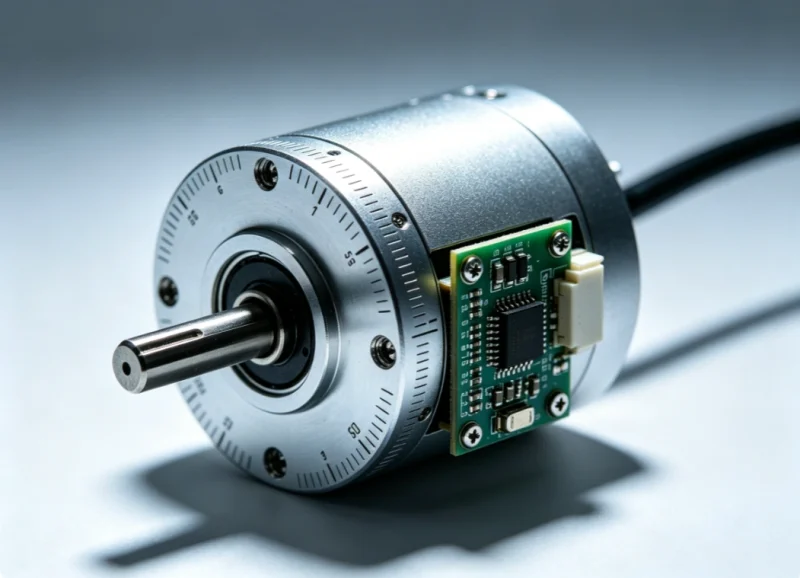
This integrated encoder is customized for precision medical motors. With an aluminum housing, built-in PCB circuit and calibrated dial scale, it precisely detects rotation angle & speed. Compact all-in-one design saves installation space, ideal for surgical instruments and medical automation equipment.
Core Integration Parameters That OEMs Must Verify
Core Integration Parameters That OEMs Must Verify
Encoder integration failure is rarely caused by quality defects, but by parameter mismatch with the motor and driver system. Three core parameters determine the final control accuracy.
-
Pulse Resolution (PPR): Higher PPR delivers finer speed and position feedback. Medical dental motors usually require 500–1000 PPR to meet micro-precision operation. Too low resolution leads to delayed feedback and unstable speed regulation.
-
Signal Anti-Interference Ability: Medical devices have compact internal wiring, which easily causes signal interference. Encoders must support stable signal output in narrow space to avoid pulse loss and data deviation.
-
High-Temperature Resistance: For clinical devices requiring autoclave sterilization, encoders must withstand 134°C high temperature and humid environment to prevent signal failure after repeated sterilization cycles.
Common Encoder Integration Challenges in Medical Devices
Common Encoder Integration Challenges in Medical Devices
Dental and medical motor integration faces unique structural and environmental constraints that do not exist in industrial scenarios. OEMs often encounter the following engineering difficulties:
-
Ultra-Compact Space Limitations: Medical handpieces have extremely narrow internal space, making it difficult to install high-precision encoders. Miniaturization easily leads to assembly deviation and signal instability.
-
Driver-Encoder Mismatch: Many universal drivers cannot identify high-precision pulse signals, resulting in failed closed-loop control, speed jitter, or unresponsive torque adjustment.
-
Sterilization Aging Attenuation: Ordinary encoders suffer signal attenuation or component aging after multiple high-temperature sterilizations, leading to reduced equipment stability in later use.
-
Mechanical Vibration Interference: Micro-vibration during motor operation interferes with encoder signal acquisition, affecting real-time feedback accuracy.
Practical Integration Checklist for OEM Engineers
Practical Integration Checklist for OEM Engineers
-
☑️ Select matched encoder type (optical/magnetic) based on device precision positioning
-
☑️ Confirm PPR resolution meets medical closed-loop precision requirements
-
☑️ Verify signal compatibility between encoder and motor driver
-
☑️ Check high-temperature and moisture resistance for sterilizable clinical devices
-
☑️ Conduct vibration and anti-interference testing after assembly
-
☑️ Calibrate speed and torque feedback to eliminate jitter and delay
-
Blindly pursuing high PPR: Excessively high resolution increases cost and assembly difficulty without obvious improvement in actual clinical effects; match parameters based on application scenarios.
-
Using industrial-grade encoders for medical devices: Industrial encoders lack high-temperature sterilization resistance and anti-interference design, unable to adapt to medical cyclic use scenarios.
-
Ignoring system matching: Focusing only on encoder quality while ignoring driver and motor coordination leads to poor overall closed-loop performance.
Encoder integration is the key to realizing high-precision control of medical and dental motors, determining equipment stability, clinical safety, and product durability. It is not a simple component installation, but a systematic matching project covering parameter selection, structural adaptation, and system debugging. Professional encoder integration solutions can effectively solve speed jitter, torque instability, and post-sterilization attenuation problems. FingerAct supports medical and dental OEMs in encoder selection, motor-encoder-driver matching, and structural integration optimization, helping manufacturers design high-precision, stable, and certification-compliant medical motion systems. Contact us for professional technical consultation and customized integration solutions.
Need precise encoder integration solutions?
Motor & driver matching support → Contact us to discuss your project.


