
How Gear Ratios Affect Dental Motor Performance
For dental device OEMs and engineers designing dental motors—especially for implant systems, endodontic tools, or lab micromotors—gear ratio is a critical yet often overlooked parameter. It directly dictates a motor’s torque output, speed regulation, and overall precision, which are non-negotiable for clinical safety and device reliability. Unlike general industrial motors, dental motors require gear ratios tailored to specific clinical tasks, where balancing torque and speed is essential. This guide breaks down how gear ratios influence dental motor performance, key considerations for selection, and common pitfalls to avoid—providing practical engineering insights to help you optimize your dental device design. With expertise in dental motor integration, FingerAct understands how to match gear ratios to your device’s unique requirements.
What Is a Gear Ratio, and Why Does It Matter for Dental Motors?
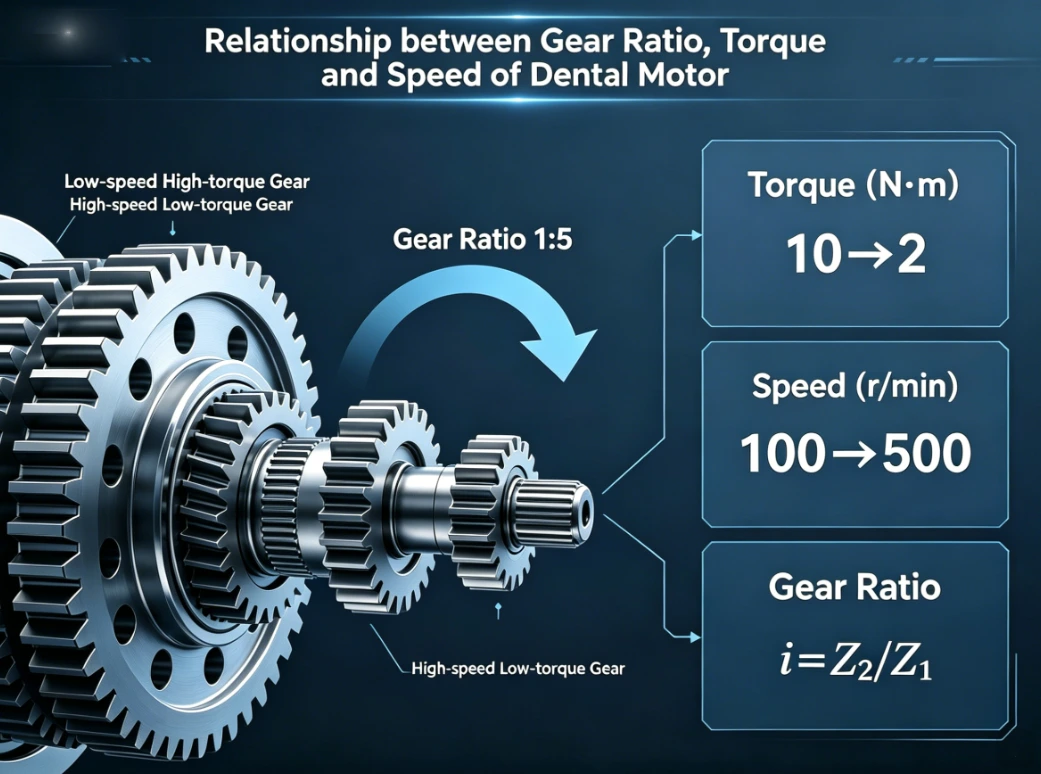
A gear ratio refers to the ratio of the number of teeth on the driving gear to the driven gear, determining how much the motor’s speed is reduced (or increased) and how much torque is amplified. For dental motors, gear ratios are not a “one-size-fits-all” setting—they must align with the motor’s core purpose, whether it’s drilling, implant seating, or precision lab work.
The core principle is simple: higher gear ratios (slower speed) amplify torque, while lower gear ratios (faster speed) reduce torque. This balance is critical for dental applications, where different procedures demand either high torque (e.g., implant seating) or high speed (e.g., pilot drilling).
How Gear Ratios Impact Key Dental Motor Performance Metrics
Gear ratios directly influence three core performance metrics that define dental motor reliability and clinical suitability:
1. Torque Amplification
Dental procedures like implant seating or dense bone drilling require high torque to ensure stability and efficiency. A higher gear ratio (e.g., 50:1) reduces the motor’s output speed but significantly amplifies torque—critical for overcoming bone resistance without stalling the motor. Conversely, a lower gear ratio (e.g., 10:1) provides less torque, making it suitable for high-speed, low-force tasks like pilot drilling.
2. Speed Regulation
Precise speed control is essential for clinical precision. Gear ratios act as a speed governor: higher ratios slow the motor’s output speed, allowing for controlled, precise movements (e.g., implant seating at 30–50 RPM). Lower ratios enable higher speeds (e.g., 800–1200 RPM for pilot drilling), while maintaining enough torque to avoid speed drops under load.
3. Precision and Vibration
Poorly matched gear ratios can lead to excessive vibration, compromising clinical precision and causing hand fatigue for clinicians. Optimal gear ratios reduce vibration by ensuring the motor operates within its efficient range, aligning torque and speed to the task at hand. This is especially critical for compact dental handpieces, where vibration can affect procedure accuracy.
Need help selecting the right gear ratio?
Email us: support@fingeract.com
Get professional advice → Contact us
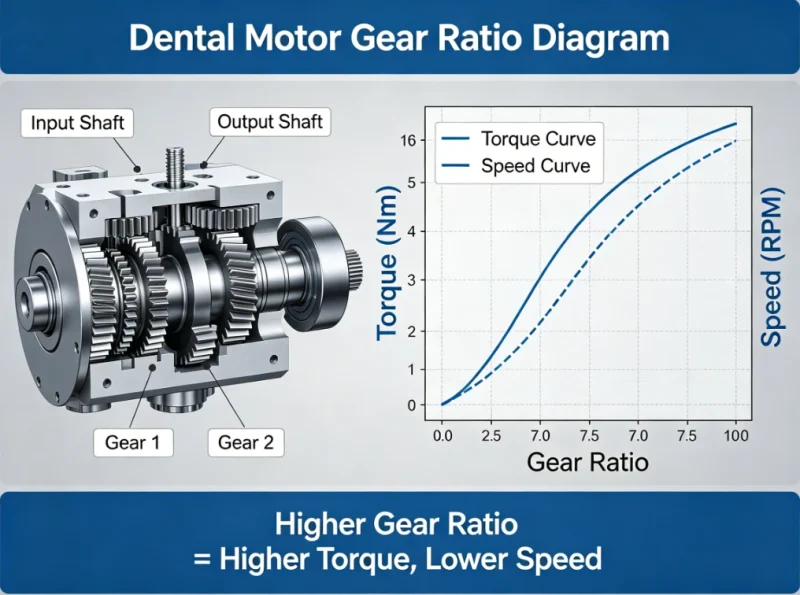
Dental motor gear ratio diagram showing the trade-off between torque and speed, critical for implant and drilling applications.
Key Considerations for Selecting Gear Ratios for Dental Motors
-
Clinical Task: Match the gear ratio to the procedure—high ratios for torque-intensive tasks (implant seating, dense bone drilling), low ratios for high-speed tasks (pilot drilling, endodontic shaping).
-
Motor Type: Brushless motors pair best with optimized gear ratios to maximize torque stability, while brushed motors may require slightly higher ratios to compensate for torque fluctuations.
-
Space Constraints: Compact dental devices (e.g., implant handpieces) require small gearboxes—select a gear ratio that balances torque/speed needs with the gearbox size.
Common Mistakes to Avoid
Common Mistakes to Avoid
-
Overlooking Gear Ratio-Motor Compatibility: Choosing a gear ratio without matching it to the motor’s native torque and speed can lead to inefficiency, overheating, or premature failure.
-
Prioritizing Speed Over Torque: For torque-intensive dental tasks, a lower gear ratio may result in insufficient force, leading to procedure delays or implant instability.
-
Ignoring Gearbox Quality: A high-quality gearbox with precise machining is essential—poorly manufactured gears can negate the benefits of an optimal gear ratio, causing vibration and wear.
Quick Gear Ratio Selection Checklist
-
☑️ Define the primary clinical task (high torque vs. high speed) to narrow down ratio range.
-
☑️ Match the gear ratio to your motor’s native torque and speed specifications.
-
☑️ Ensure the gearbox fits your device’s space constraints.
-
☑️ Prioritize high-quality gear machining to reduce vibration and extend lifespan.
Gear ratios are a foundational factor in dental motor performance, directly impacting torque, speed, and precision—all critical for clinical safety and device reliability. By understanding how gear ratios work and aligning them with your clinical needs, you can optimize your dental device design and avoid common pitfalls. FingerAct supports dental OEMs in selecting and integrating optimal gear ratios, ensuring your motor performs seamlessly in real-world clinical scenarios. Contact us today to discuss how we can help match gear ratios to your dental motor requirements.


