

Typical Speed and Torque Requirements for Endodontic Motors
For dental device OEMs and engineers designing endodontic motors, defining the right speed and torque requirements is a critical step in ensuring clinical efficiency and device reliability. Endodontic procedures—such as root canal shaping and cleaning—demand precise control over motor performance, where even small deviations in speed or torque can compromise treatment outcomes. Many OEMs struggle to balance these parameters with compact device design and integration constraints, leading to motors that fail to meet clinical needs. This guide breaks down the typical speed and torque requirements for endodontic motors, key factors influencing parameter selection, and practical integration insights—helping you optimize your endodontic device design. With expertise in dental motor development and OEM integration, FingerAct supports you in matching motor parameters to clinical demands.
Key Requirements: Speed Ranges for Endodontic Motors
Typical Torque Requirements for Endodontic Motors
Need help with endodontic motor speed/torque?
Email us: support@fingeract.com
Get professional advice → Contact us
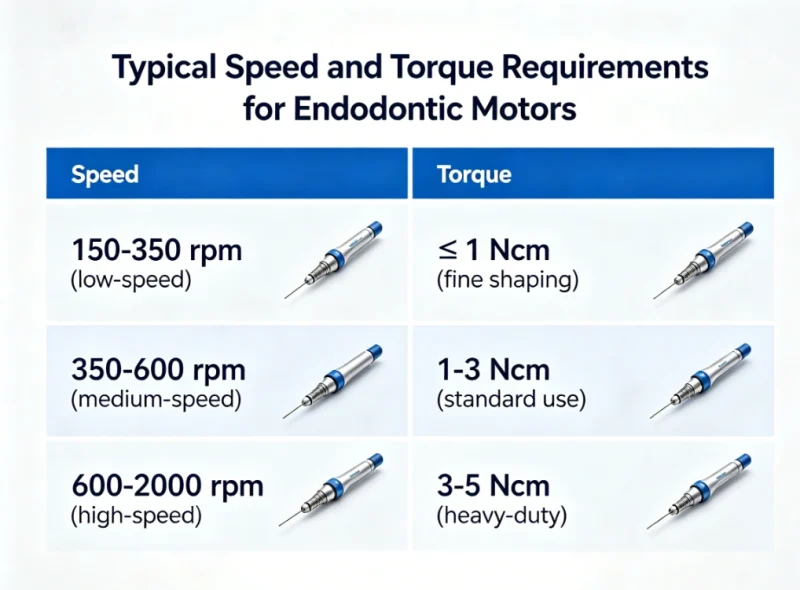
This chart shows typical speed and torque ranges for endodontic motors, matched to clinical tasks.
Factors Influencing Speed and Torque Selection
-
Instrument Type: Nickel-titanium (NiTi) instruments require lower torque and speed to prevent fatigue and breakage, while stainless steel instruments can handle slightly higher torque.
-
Canal Complexity: Curved, narrow canals demand lower speed and torque to avoid instrument binding, while straight, wide canals can accommodate higher parameters for efficiency.
-
Device Size: Compact endodontic handpieces require motors with optimized speed-torque ratios, as space constraints may limit motor size and power output.
Common Mistakes in Speed and Torque Selection
-
Overlooking Instrument Compatibility: Matching speed and torque to the instrument type (NiTi vs. stainless steel) is critical—using excessive torque for NiTi instruments leads to breakage and clinical risk.
-
Prioritizing Speed Over Precision: Higher speed does not equal better performance; for endodontic procedures, precision is key, and excessive speed can cause overheating and tissue damage.
-
Ignoring Integration Constraints: Failing to align speed and torque requirements with the motor’s driver and encoder can lead to inconsistent performance, torque fluctuations, or system failure.
Quick Selection Checklist
-
☑️ Define speed ranges based on core endodontic procedures (access, shaping, cleaning).
-
☑️ Match torque to instrument size and type (NiTi vs. stainless steel).
-
☑️ Ensure torque limiting features are integrated to prevent instrument breakage.
-
☑️ Align speed-torque ratios with device size and integration constraints.
-
☑️ Verify speed stability under variable loads for clinical precision.
The typical speed and torque requirements for endodontic motors are defined by clinical needs, instrument compatibility, and device design constraints. By adhering to industry-standard ranges and avoiding common selection mistakes, you can design an endodontic motor that delivers reliable, precise performance for root canal procedures. FingerAct supports dental device OEMs in optimizing speed and torque parameters, ensuring seamless integration with your device’s control system and clinical requirements. We offer customization and integration support to match motor performance to your endodontic device’s unique needs. Contact us today to discuss your endodontic motor requirements.
Optimize endodontic motor parameters?
Integration + customization → Collaborate


